
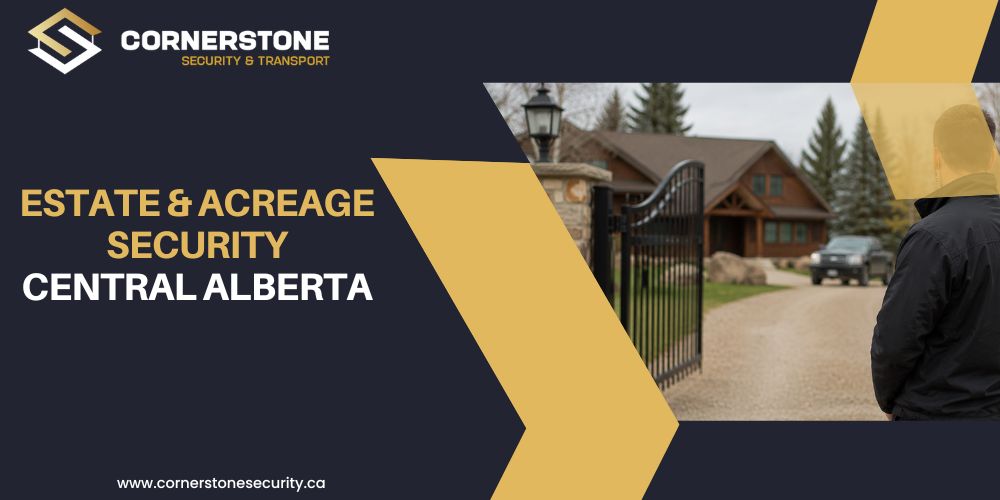
Rural and acreage properties in Central Alberta present a security challenge that is fundamentally different from what most protection firms are designed to address. The threat profile is different, the geography is different, and the operational requirements are different. A firm that excels at urban close protection does not automatically know how to secure a 160-acre property outside Red Deer — and the gap between those two capabilities matters.
For high-net-worth families, agricultural business owners, and senior executives who live or work outside of city centres, this distinction is not abstract. It shapes whether the security measures in place are actually effective or simply present.
Why Rural Properties Have a Different Risk Profile
Urban executive protection operates in an environment where infrastructure is dense. Emergency services are close. Roads are monitored. There are witnesses. Rural and acreage properties invert most of those conditions. Response times are longer. Perimeter boundaries are larger and harder to monitor. Access points are more numerous and less controlled. And the absence of nearby population means that incidents can develop without any external pressure to interrupt them.
Rural properties in Central Alberta are often associated with agricultural operations or energy sector work — both of which carry their own risk profiles. Agricultural businesses can be targets for theft, particularly during harvest periods when equipment values are high. Energy sector executives and landowners can attract attention from disgruntled former employees or individuals with grievances related to their professional activity.
Furthermore, the lifestyle characteristics of acreage living — predictable routines, known entry points, and long periods without neighbouring activity — create the kind of environmental predictability that risk actors exploit. A household that follows the same morning routine, uses the same gate access, and has the same vehicles in the driveway at the same times is a household whose patterns are legible to anyone watching.
Perimeter and Residential Security Measures
Effective rural estate security starts with a site assessment. Before any measures are put in place, the property needs to be understood — its access points, its sight lines, its vulnerabilities, and the ways in which its current configuration either supports or undermines a protective posture.
Perimeter security on a large rural property typically involves a layered approach: detection at the boundary (sensor systems, cameras with appropriate coverage fields), controlled access at entry points (gate systems, intercom protocols), and residential hardening at the home itself (door and window reinforcement, interior safe rooms, alarm systems integrated with monitoring). Each layer serves a different function, and the effectiveness of the whole depends on how well they work together.
A residential security assessment from Cornerstone evaluates all of these elements in the context of your specific property and your specific lifestyle. The measures we recommend are not a catalogue of products — they are a response to what we find when we look at your property the way a threat actor would.
Protecting the Family vs. Protecting the Operation
For many of our clients in Central Alberta, the property is both a home and a working operation. Those two contexts require different thinking about security.
Family protection — particularly when children are present — prioritizes presence and response. It involves ensuring that family members can reach help quickly, that the home environment is hardened against intrusion, and that the household has clear protocols for different types of incidents. In cases where the threat level is elevated, a residential agent provides a physical protective presence that no technology system can replicate.
Operational security — protecting equipment, livestock, crops, or business assets — involves monitoring, access control, and coordination with staff. It is a different discipline, and it involves understanding the rhythms of the operation: who is on the property, when, and doing what. This is evident through the kinds of incidents that happen most frequently on agricultural properties: opportunistic theft during off-hours, internal theft by people with legitimate access, and vandalism or sabotage driven by personal or political grievance.
Ultimately, the most effective security plan for a rural estate is one that accounts for both contexts without conflating them. The measures that protect a family from an intruder are not the same measures that protect a grain shed from theft. Both are necessary; neither replaces the other.
Secure Travel Along the QEII Corridor
The QEII Highway between Calgary and Edmonton runs through the heart of Central Alberta and is the primary travel route for executives and professionals moving between the province’s two major centres. For clients based in the Red Deer area, the corridor is a daily reality — and a consistent security consideration.
Highway travel creates a specific vulnerability that urban movement does not: an extended period of predictable route in a controlled vehicle environment. A principal who travels the QEII regularly on a consistent schedule is following a legible pattern. Secured driving — a trained security driver, a vetted vehicle, and route variation where appropriate — addresses that vulnerability without disrupting the client’s travel needs.
For clients who require movement between Red Deer, Calgary, and Edmonton, our teams coordinate across all three areas. A detail that originates in Red Deer can connect with resources in either direction along the corridor, providing continuity of coverage across the full scope of a client’s Central Alberta operations. This connects directly to our executive protection services in Red Deer and extends seamlessly to both Calgary and Edmonton as required.
Coordinating with Local Emergency Response
Rural security does not operate in isolation from local law enforcement and emergency services. One of the most important elements of a rural estate security plan is understanding the local response environment: what RCMP detachment covers the property, what the realistic response time is, and how to ensure that an incident report reaches the right people quickly.
A professional security assessment establishes those contact protocols and builds them into the household’s emergency plan. In cases where a residential agent is deployed, coordination with local response is part of the agent’s operating brief — not an afterthought. The goal is not to replace local law enforcement but to ensure that, in the window between an incident and law enforcement arrival, there are professionals on-site with a clear plan.
— Justice Osei, Founder, Cornerstone Security